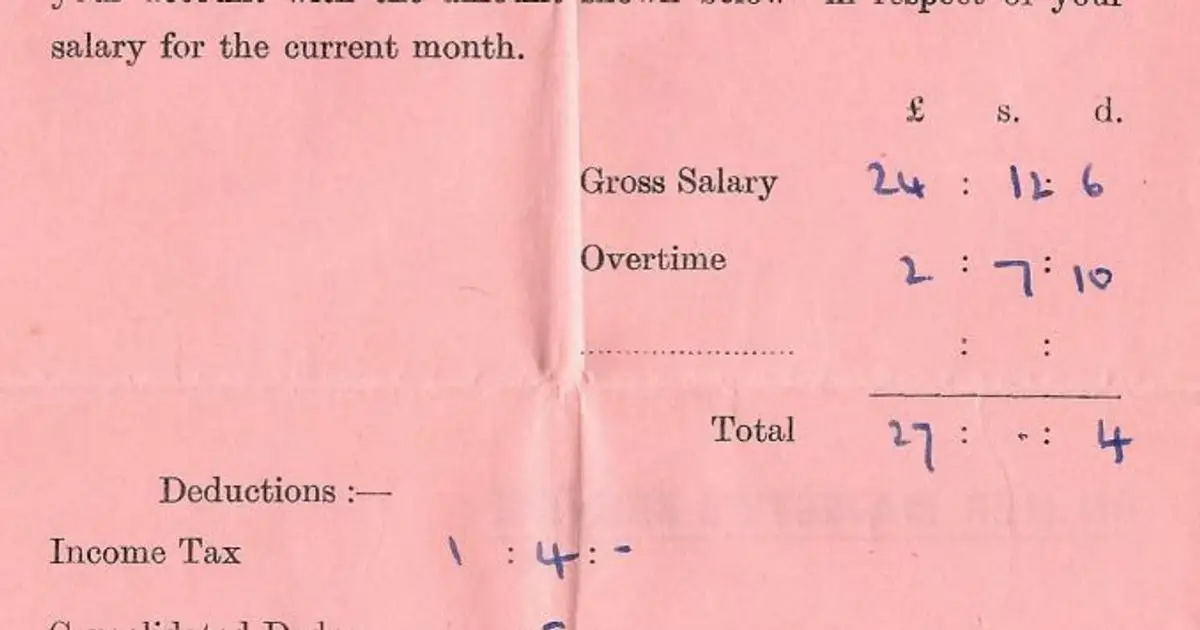
On a £36,000 salary in 2026/27, outside Scotland, you pay £4,686 in income tax and about £1,874 in National Insurance. That leaves about £2,453 a month, before any pension or student loan deductions.
Those two figures come from separate calculations with separate thresholds. Once you can see each one, a payslip gets a good deal less mysterious. This article takes a plain employee on one job and works through it, using the figures published on GOV.UK for the tax year running from 6 April 2026 to 5 April 2027.
Three salaries, side by side
| Each month | £24,000 | £36,000 | £60,000 |
|---|---|---|---|
| Gross pay | £2,000.00 | £3,000.00 | £5,000.00 |
| Income tax | −£190.50 | −£390.50 | −£952.67 |
| National Insurance | −£76.16 | −£156.16 | −£267.50 |
| Left | £1,733.34 | £2,453.34 | £3,779.83 |
Our arithmetic, assuming tax code 1257L, even monthly pay across the year, and no pension, student loan or benefits in kind. Real payslips round differently and can differ by a few pence.
How the income tax sum works
Income tax is charged in slices. GOV.UK lists the 2026/27 slices as follows: nothing on the first £12,570, which is the Personal Allowance. Then 20% on income from £12,571 to £50,270, 40% from £50,271 to £125,140, and 45% above that.
For the £36,000 salary, take off the allowance and £23,430 remains. All of it falls in the 20% slice, which gives £4,686 for the year, or £390.50 a month.
The £60,000 salary shows the part that catches people out. Moving past £50,270 does not push the whole salary up to 40%. Only the pounds above the line pay the higher rate.
What happens above £100,000
The Personal Allowance shrinks by £1 for every £2 of adjusted net income above £100,000, and reaches nothing at £125,140. Someone with adjusted net income of £110,000 has an allowance of £7,570. It is a band where getting an accountant to look at the numbers can make sense, because pension contributions and other details change the result.
How National Insurance differs
Employee National Insurance runs on its own rules, and the one to remember is that it is worked out pay period by pay period. For 2026/27, the Class 1 employee rates are 8% on monthly pay between £1,048 and £4,189, then 2% on anything over £4,189.
On £3,000 a month, that is 8% of £1,952, or £156.16. On £5,000 a month, it is 8% of £3,141 (£251.28) plus 2% of £811 (£16.22), making £267.50.
So a month with a large bonus can look odd. If our £36,000 earner gets a one-off month of £5,000, National Insurance for that month is £267.50, not a steady £156.16. The next month it goes straight back. It is not a mistake on the payslip, just the pay-period rule at work.
The tax code on your payslip
Your employer does not work out your allowance from scratch. It follows the code HMRC gives it. GOV.UK explains that 1257L is the code used for most people with one job or pension: 1257 stands for the £12,570 allowance with the last digit dropped, and L means you get the standard tax-free allowance.
Other codes are worth a second look. M1, W1, X and NONCUM at the end of a code mean you are on an emergency code, often seen after starting a new job. A lower number can mean HMRC is collecting tax on something else through your pay, such as interest on savings, which we cover in our guide to tax on savings interest.
You can see your code in your HMRC online account, in the HMRC app or on your payslip. The GOV.UK tax codes guide also explains what to do if it looks wrong.
If you live in Scotland
Scottish taxpayers have the same £12,570 allowance but different slices. The 2026/27 Scottish rates are 19% to £16,537, 20% to £29,526, 21% to £43,662, 42% to £75,000, 45% to £125,140 and 48% above.
By our arithmetic, income tax on £36,000 comes to about £4,711 in Scotland, roughly £25 a year more than elsewhere. The gap widens quickly higher up, since the 42% rate starts at £43,663. Savings interest and dividends are taxed at the same rates as the rest of the UK, according to the same page.
Run the sum on your own payslip
You only need three figures from a monthly payslip: gross pay, the tax code and the National Insurance line. Then try this:
- For National Insurance, take gross pay and subtract £1,048. Multiply by 8%, up to £4,189 of pay, and add 2% of anything above that. Compare it with the payslip.
- For income tax on code 1257L, multiply gross pay by 12 and take off £12,570. Apply the slices above, then divide by 12.
If you pay into a pension before tax, use your pay after that deduction for the tax line. If the result is a long way off, and you can't explain it with a bonus, a new job or a change of code, that is the moment to look at the code and ask your payroll team or HMRC.
What the sums leave out
These tables are a starting point. Real take-home pay also depends on things we have stripped out for clarity:
- Pension contributions, which can come out before tax. Our workplace pension guide has the sums.
- Student or postgraduate loan repayments.
- A second job, which usually has its own tax code.
- Self-employed income, which follows a different system entirely.
Once you know your monthly figure, it becomes the top line of a household budget.
This is general information, not tax advice. If your income comes from several places, or you think you have paid the wrong amount for more than a year or two, speak to HMRC or a qualified tax adviser.